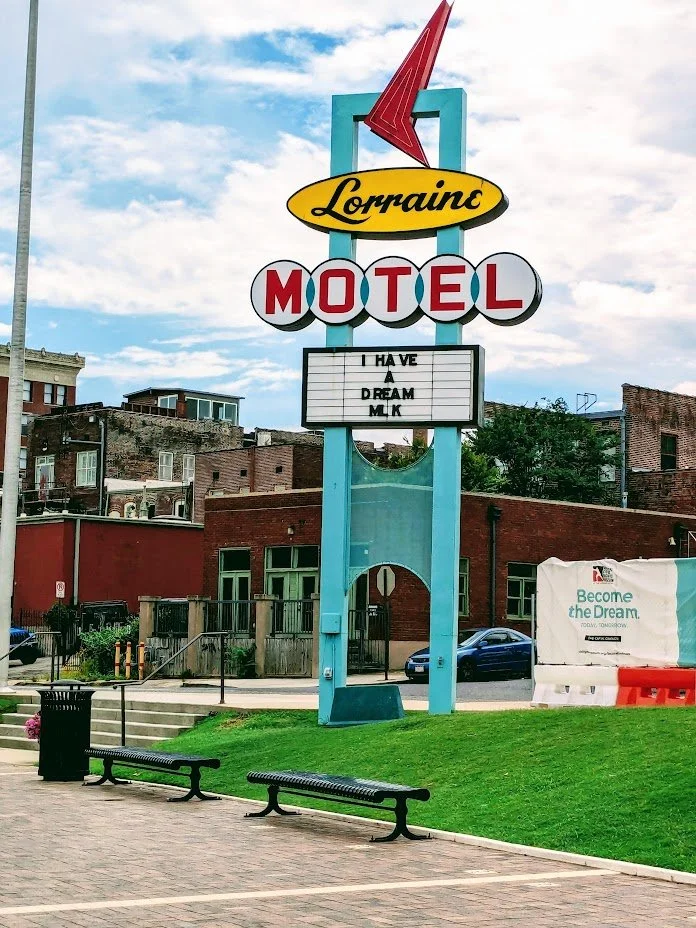
The Lorraine Motel and National Civil Rights Museum
Why do I love to travel? Well, it’s not only to feel the excitement of going to those places I could only dream of seeing in my boyhood imagination, it also allows me to actually put myself in those settings. When I’m on the road, I can let the inner child in me out. Strolling along 5th. Ave. in New York City, soaking in its sights and sounds brings a thrill that living a life in towns of merely 900-1,000 citizens couldn’t satisfy. Rolling through vast prairies and deserts have me seeing Cowboys and Indians hiding behind every scrub and cacti waiting to waylay the very train I’m travelling on. Watching the surfers ‘‘hanging 10’’ on a 20 ft. wave at Pismo Beach takes me back to Saturday afternoon movies featuring Annette and Frankie dancing with wild abandon in those cheesy surfing movies. I so wanted to live in California, I also wanted to be one of those blue-eyed, blond-haired, tanned teenagers who always seemed to have a cool hot rod and a seemingly endless supply of money. But, day-dreams aside, I also love to travel because there is no better way to experience history and geography first-hand than to travel.
On my journeys, I not only take in the fun and exciting adventures I’ve mentioned above, but also seek out the monuments and sites that shaped our history. It seems that for every joyful memory shaped by a movie or book, there is a memory that helped shatter my idyllic young life and brought me hurtling back down to earth. I have been fortunate to have visited two of those very sites that I can vividly remember watching on the TV in our den, tears streaming down my little face, as my heroes' bright lights were snuffed out. My visits were not ‘‘fortunate’’ in a thrill-seeker's sort of way, but rather pilgrimages I was finally able to make to pay homage to my fallen heroes. One was in Dallas, the other was in Memphis. I guess as I was in my early teens when Dr. King was assassinated, it left more of a lasting, deeper impression on me. I made a stop in Memphis last year and had a long list of famous sites to visit. Of course, I had to see Sun Studios, that iconic building that kick-started the Rock and Roll genre and the careers of Elvis, Johnny Cash, Jerry Lee Lewis, Carl Perkins, and Howlin’ Wolf, to name just a few. I took a walk along Beale St. and Union Ave., while listening to the sounds of B.B. King and Marc Cohn on my MP3 Player before visiting the Blues Hall of Fame Museum. But I wanted to save my stop at The Lorraine Motel for last, I wanted to allow myself lots of time so that I could absorb the 400 years of atrocious history I knew that I would discover within. I just wasn’t prepared for how abhorrent it would be.
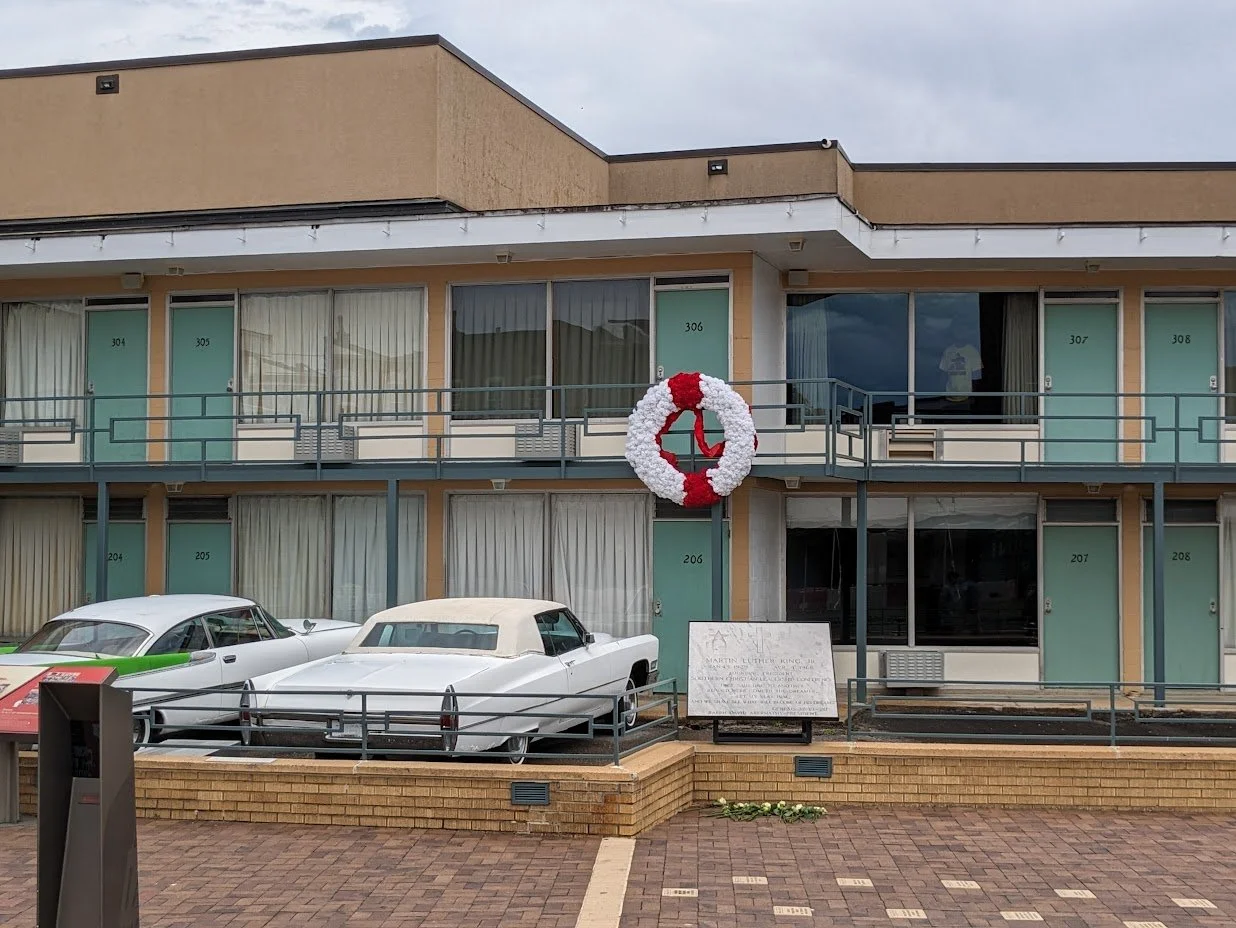
Walking down Mulberry St., now Dr M.L.K. Jr. Ave., you are suddenly in the parking lot of the Lorraine Motel. Looking straight ahead, you see a white 1968 Cadillac and a white 1968 Dodge Polaris parked below room 306, looking much the same as it would have on that fateful day in 1968, except that now there is a huge white wreath hanging on the balcony marking Dr King's approximate position at the moment of his assassination. I wasn’t prepared for the feeling that came over me as I stood gazing at a landmark that had been imprinted on me so many years ago. Having witnessed the loss of President Kennedy 5 years earlier, the added loss of another leader who had taken up the fight for so many who were struggling just to have the right to have what so many of us, me included, took for granted, I was completely overwhelmed. The sudden loss of my youthful innocence came flooding back; I could feel my throat constrict, and I felt a tear roll down my cheek. There were perhaps 10 other folks in the parking lot, all as I was, just staring up at that white wreath. Not a soul uttered a word as if in reverence to the man we had come to honour.
I made my way to the museum, which I thought would be anti-climactic; I was wrong. Right from the start, it was 2 hours of education that couldn’t be taught in a classroom. The displays showed the progression of the African peoples to the African-American peoples, right up to the present BLM movements and the struggles they endured every step of the way. The way the slaves were packed into the holds of those ships was almost inconceivable. Another display of great interest was the bus that Rosa Parks rode, which began what came to be known as the Montgomery Bus Boycott. However, the display that really drove home the horror of the struggles endured by the Civil Rights movement activists had to have been the burnt shell of a Greyhound Bus that had been attacked and destroyed by segregationists. It only seemed like yesterday that we heard about these atrocities and watched nightly as these unbelievable events were unfolding in our dens. Thankfully, we have come far in our ability to treat all humankind as equal. It’s museums just like this one that teach us a better way to live, treating our neighbours as brothers and sisters. To learn more about the National Civil Rights Museum in Memphis, I attach this link to their website for your perusal: https://civilrightsmuseum.org/